
A Task-Scoped Cross-Border Trust Stack for AI Agents
This research outlines a framework for establishing a task-scoped cross-border trust stack that enables autonomous AI agents to operate securely across different legal jurisdictions. Current systems are siloed, as data consent and financial payment authorizations lack the cryptographic binding necessary for international verification. To bridge this gap, this paper proposes a unified authorization artifact that links task-specific permissions, payment mandates, and final settlement records into a single, verifiable chain. This approach relies on the principle of local authorization with interoperable verification, allowing domestic identity and banking systems to remain intact while providing a standardized audit trail. By fusing these technical dimensions, the proposed model ensures non-repudiation and provides clear evidence for legal liability in global autonomous commerce, creating a techno-legal framework where complex agent actions are both mathematically provable and legally recognized worldwide.
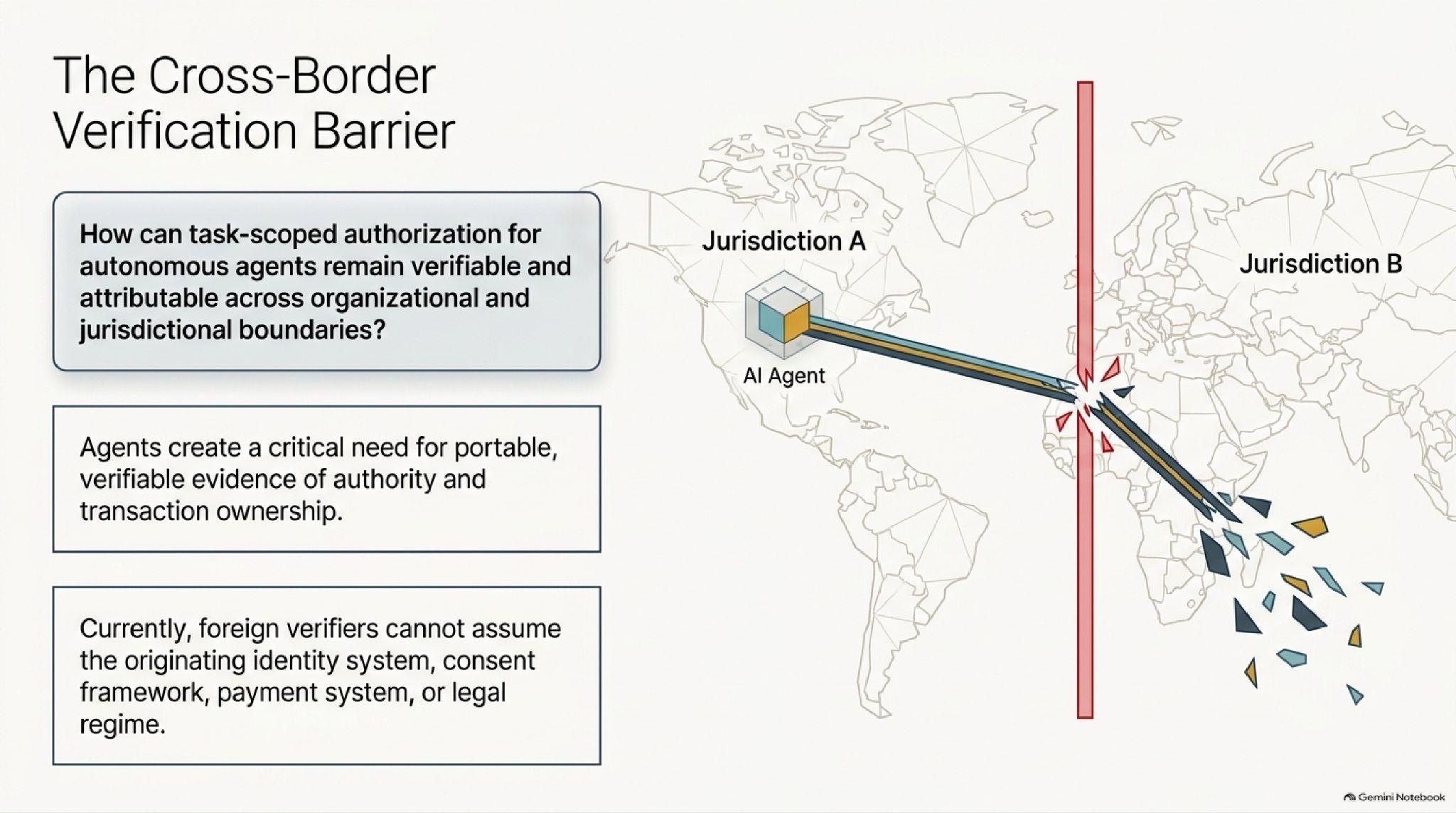
The Cross-Border Verification Problem
How can task-scoped authorization for autonomous agents, covering data consent and financial authority, remain verifiable and attributable through the resulting transaction/settlement across organizational and jurisdictional boundaries?
Existing systems like Doot from India is an initiative to define open standards for AI agents for every Indian citizen. The Agent Authorization Ticket (AAT) from this Doot architecture provides the agent consent and delegation. Other systems like A2A for agent communication, AP2/x402-like protocols for agent payment authorization, and existing financial infrastructure for settlement provide pieces of this stack.
The capabilities of this stack remain siloed. Doot/AAT handles consent + delegation (in Indian jurisdiction only). AP2 handles payment auth. excellently, and Project Agora from BIS recently piloted a multi-jurisdiction settlement for tokenized wholesale transactions.
Domestic systems solve the authentication + settlement problem in a simple manner because all parties, such as the user, agent, and payment infrastructure, are within the same jurisdiction. And to regulate and verify the agent action after the task is done is not that big of a deal if the workflow is designed in that way.
For example, Doot can use its Agent Authorization Ticket (AAT), Agent Governance Manager (AGM), Indian identity infrastructure (Aadhaar), Indian consent rules (DEPA), and domestic payment infrastructure (UPI). The institutions already understand the meaning of those artifacts.
The issue becomes much more important internationally because the verifier cannot assume the originating authorization system, identity system, consent framework, payment system, or legal regime, and yet they need to determine whether an agent even has the authority to perform the transaction and whether the resulting settlement can be attributed to that authority.
The Convergence Point: A Fused Artifact
So agents create this need of portable, verifiable evidence of authority and transaction ownership.
These three primitives are different in a current system:
- A consent artifact permits data access,
- A separate mandate or token authorizes payment,
- And settlement occurs on another rail,
And this is happening w/ no cryptographic or architectural binding between the three.
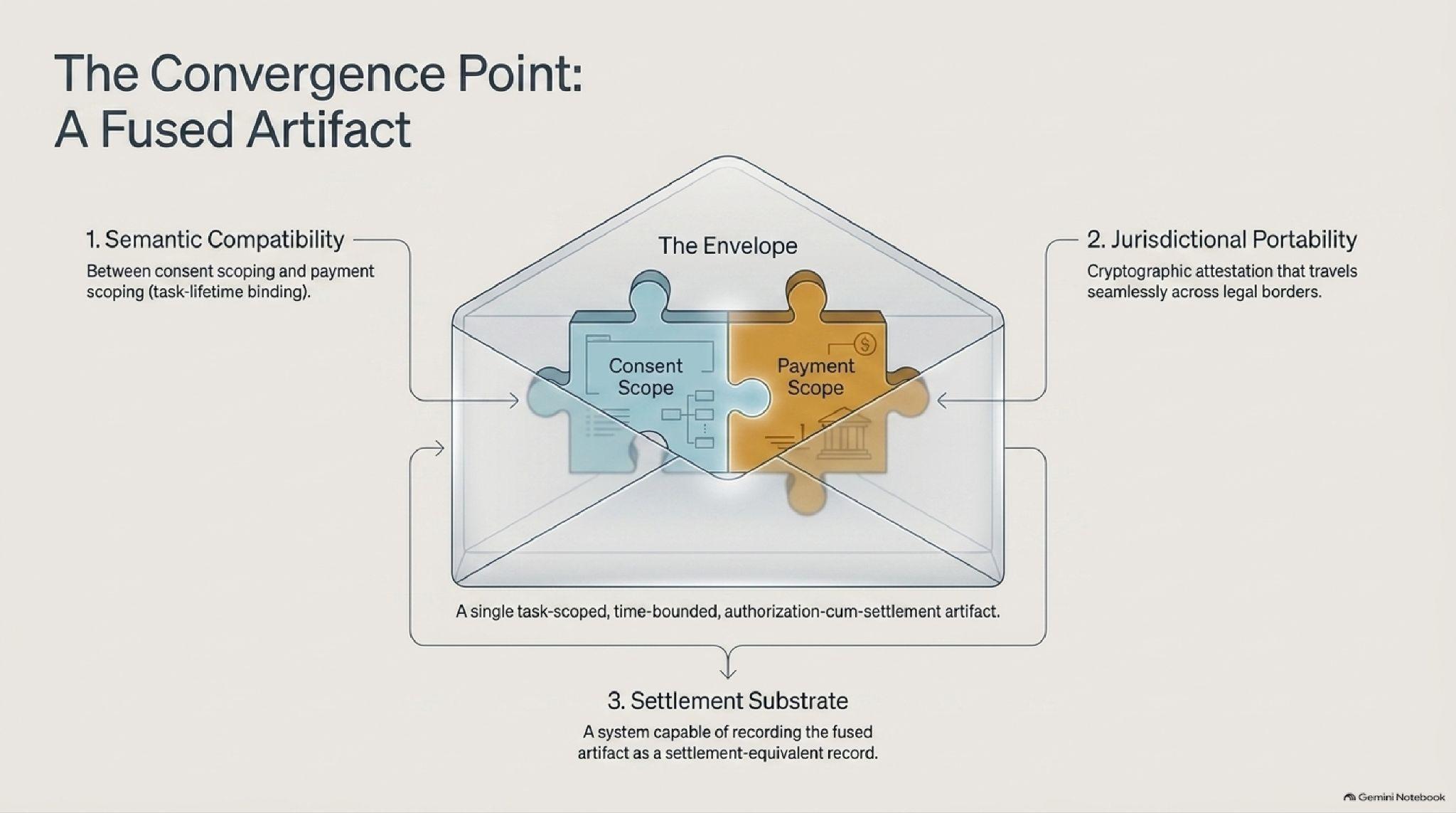
To solve the issue of cross-border portable, verifiable evidence of authority and transaction ownership, it needs to come at one convergence point, i.e., a single task-scoped, time-bounded, authorization-cum-settlement artifact.
To make this artifact work in a cross-border environment, we need these requirements:
- Semantic compatibility between consent scoping and payment scoping.
- Settlement substrate capable of recording the fused artifact as a settlement-equivalent record.
- Portability of that artifact across legal and regulatory jurisdictions.
The beauty of this artifact is we can take inspiration for these requirements from current real-world engineering systems.
- Semantic compatibility between consent scoping and payment scoping.
- End-to-end argument + task-lifetime binding
- Possible translation: Consent scope and payment scope into a common task-scoped authorization artifact whose semantic legitimacy remains with the principal/payment parties, while the broker mechanically verifies scope conformance.
- Settlement substrate capable of recording the fused artifact as a settlement-equivalent record.
- GSM roaming / TAP
- Possible translation: Roaming model's provisional authorization → execution → standardized post-hoc settlement/reconciliation into a settlement record carrying the fused authorization artifact.
- Portability of that artifact across legal and regulatory jurisdictions.
- RPKI/BGP + GSM roaming/TAP
- Possible Translation: Cross-domain cryptographic attestation into recognition of foreign mandate authority, then translate roaming's home-network/visited-network trust + reconciliation into cross-jurisdiction recognition and liability settlement.
End-to-End Conceptual Lifecycle
A simple mental model can be formed that shows the end-to-end lifecycle of an agent action across different conceptual, cryptographic, and institutional layers:
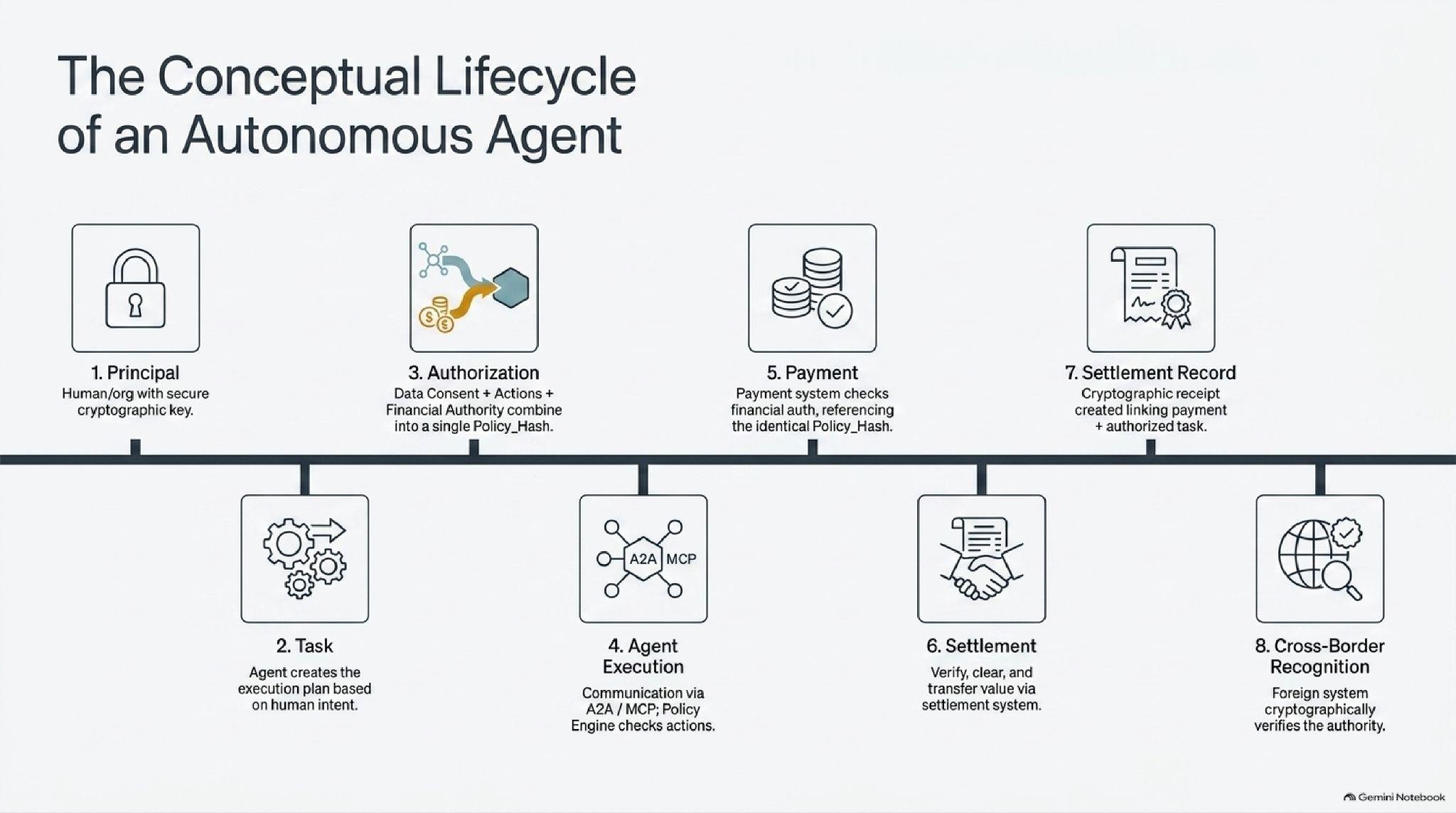
- Principal
- Human or organization that owns the authority
- Secure Cryptographic Key
- Human or organization that owns the authority
- Task
- Humans define what needs to be done
- The agent creates the execution plan
- Humans define what needs to be done
- Authorization
- Data Consent
- Agent Actions
- Financial Authority
- All combined into a single authorization
- Policy_Hash
- All combined into a single authorization
- Agent Execution
- Agent communicates through A2A / MCP
- Policy Engine checks every action.
- Payment
- The payment system checks the financial authorization
- Payment reference the same policy_hash
- The payment system checks the financial authorization
- Settlement
- Verify and clear the transaction
- Transfer value through the settlement system.
- Settlement Record
- Create a cryptographic receipt
- Links payment + authorization task
- Create a cryptographic receipt
- Cross-Border Recognition
- A foreign system verifies the authorization cryptographically
- No need to trust its internal processes
- Legal liability is handled between jurisdictions.
Fusing Data Consent and Financial Authority
Data consent and financial authorization have evolved along strictly separated institutional and technical tracks:
Data consent (DEPA, AA, ISO 29184, FIDA, and GDPR) was scoped by purpose and resource type and governed by data protection law, but it omits the consent artifact/receipt and is blind to financial value transfer.
On the other hand, financial authorization (AP2, x402, ACP, and card schemes) was scoped by currency amount and MCC and governed by central banks and card rules, but it omits the payment mandate and tokens and is blind to personal data provenance.
In real-world autonomous commerce, these two domains cannot remain separate. For example, when an AI agent purchases medical insurance on behalf of a citizen:
- It must access private health and identity data (requiring granular data consent).
- It must commit funds up to a limit (requiring financial payment authority).
- The validity of the payment is legally contingent upon the validity of the data consent.
Currently, no production standard fuses both dimensions into a coherent, verifiable delegation artifact.
Grounding AI Commerce in Settlement Reality
Clear terminology is required in this dialogue for settlement regarding the financial market infrastructure.
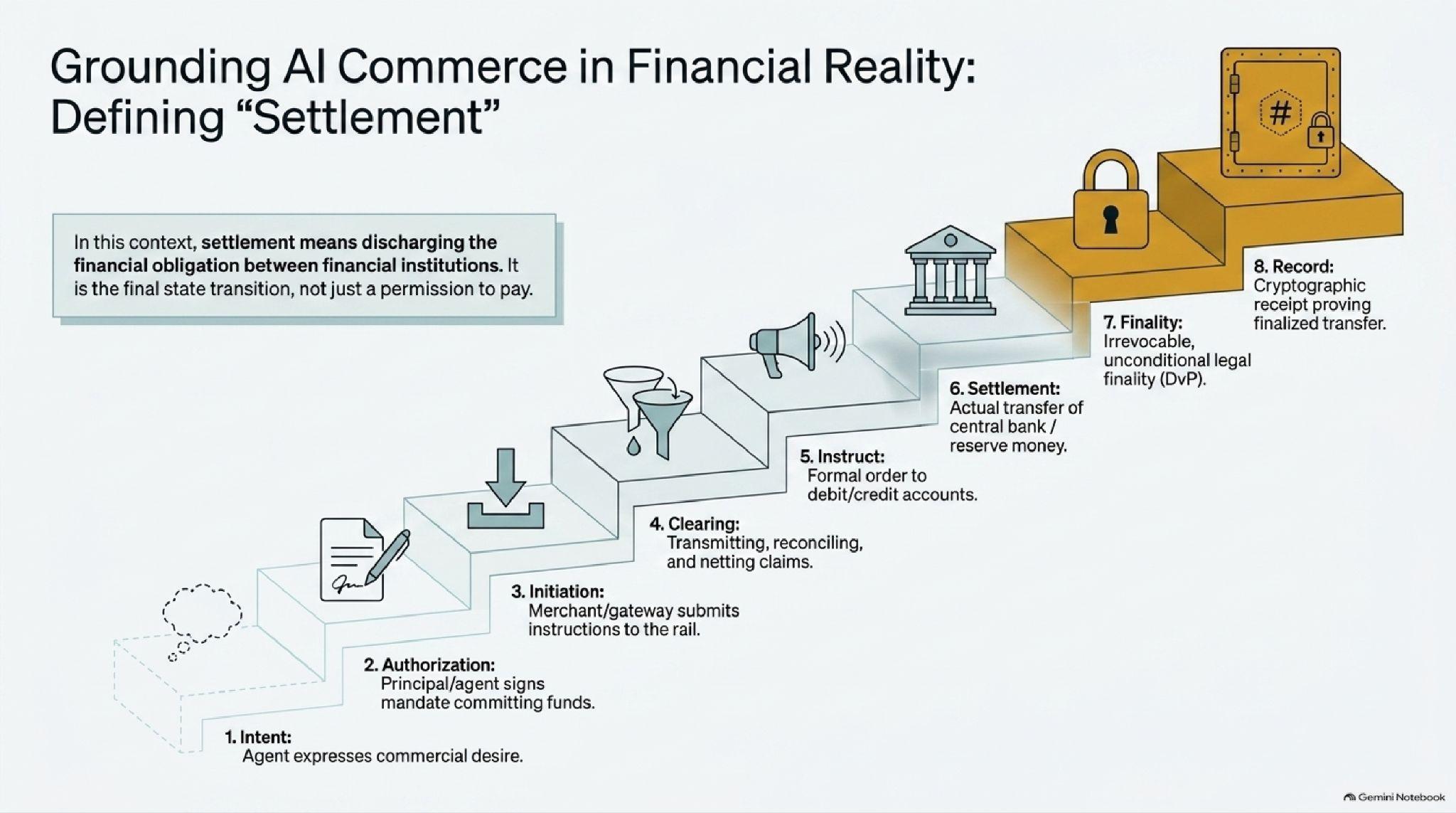
- Payment Intent: Agent expresses commercial desire to purchase.
- Payment Authorization: The principal/agent signs a mandate committing funds.
- Payment Initiation: The merchant/gateway submits instructions to the rail.
- Clearing: Transmitting, reconciling, and netting claims.
- Settlement Instruct: Formal order to debit/credit settlement accounts.
- Settlement: Actual transfer of central bank / reserve money.
- Settlement Finality: Irrevocable, unconditional legal finality (DvP).
- Settlement Record: Cryptographic receipt proving a finalized transfer.
In this context of cross-border agent authorization, settlement means discharging the financial obligation between the relevant financial institutions. This is the final state transition, not a permission to make the payment.
The Necessity of Cryptographic Binding
The most obvious argument also comes that why not keep everything separate.
Assume three completely independent systems operating without cross-layer binding:
- AAT #123 issued by principal P to agent A.
- Payment Auth. #456 Agent A generates a payment mandate of $2,000 to Merchant M via Payment Gateway G.
- Settlement #789, settlement rail S, settles $2,000 from P's bank to M’s account.
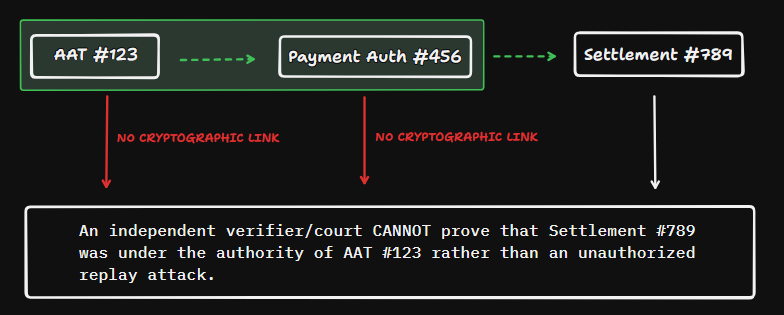
As outlined in the above image, keeping the artifacts completely separate destroys end-to-end non-repudiation and makes autonomous cross-border dispute resolution impossible. Therefore, lightweight cryptographic binding envelope linking their respective digests is strictly necessary.
Local Authorization, Interoperable Verification
The entire artifact is based on one principle, i.e., Local Authroization, Interoperable Verification.
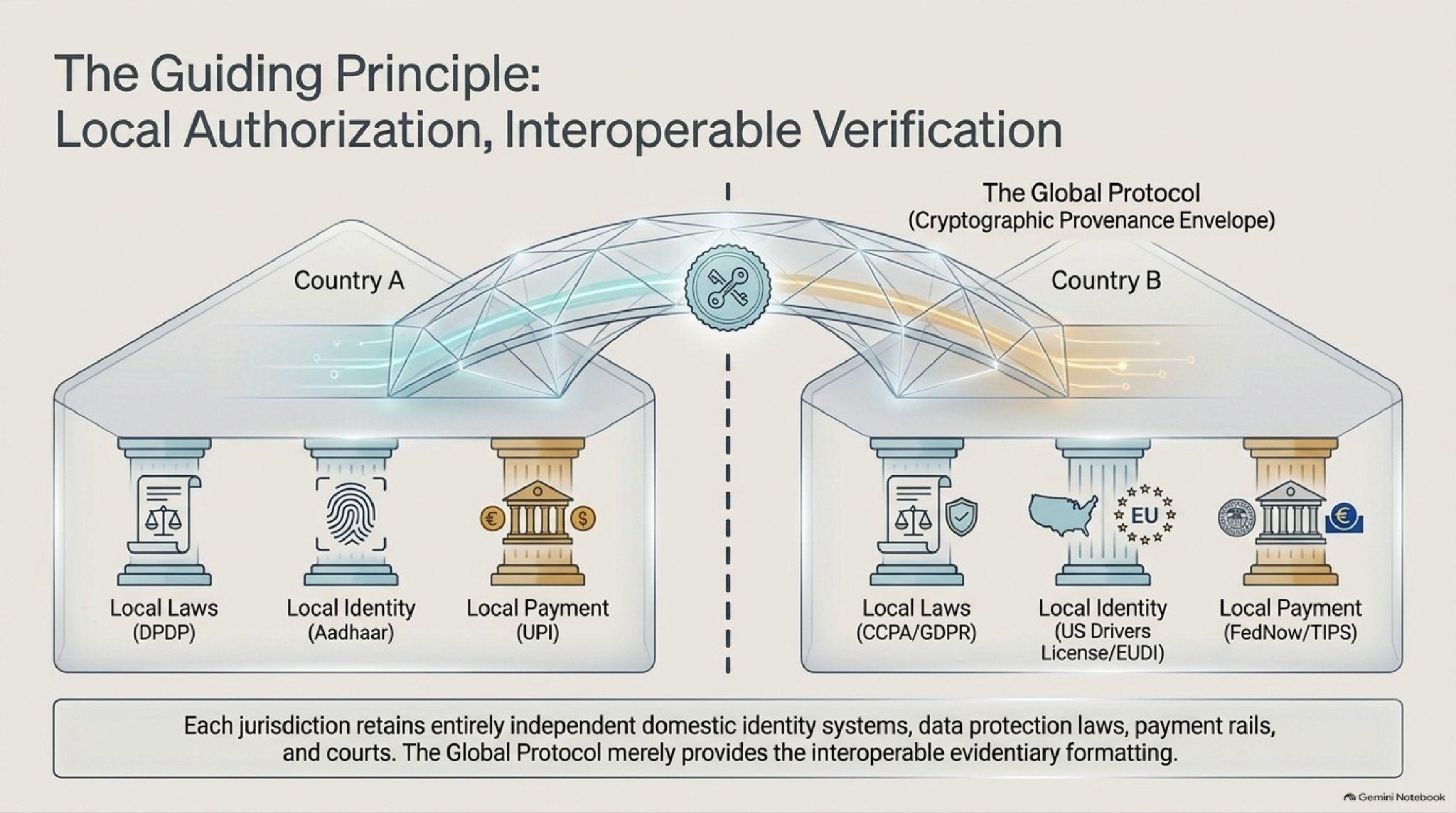
Under this principle:
- Each jurisdiction retains its domestic identity systems (Aadhaar, EUDI Wallet, and US driver's licenses), data protection laws (DPDP, GDPR, and CCPA), payment rails (FedNow, UPI, and TIPS), and courts.
- The Global Protocol provides an interoperable cryptographic provenance envelope that formats signatures, hashes, caveats, and settlement references into standardized evidence objects admissible under international electronic transactions law.
For cross-border agent authorization, a difference between proof and legal liability is required:
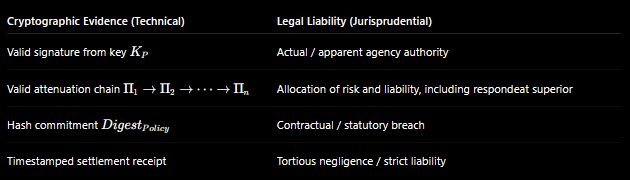
- Cryptographic Proof DOES NOT EQUAL Legal Liability: Proving mathematically that key K signed a payment mandate does not automatically resolve whether Principal P is liable if K was compromised or acted outside ostensible authority.
- What the cryptographic provenance scheme does establish is an immutable, non-repudiable audit trail that satisfies statutory requirements for electronic evidence.
Addressing Counter-Arguments
Some possible counter arguments:
- Is the real problem clearing and conformance?
- Clearing verifies contract obligations, but the Oracle Problem mathematically bounds automated general-purpose conformance. Binding can focus on auditable authorization-to-settlement linkage rather than attempting to solve the uncomputable general conformance issue.
- Is the real issue legal recognition?
- Technical protocols cannot rewrite national laws, but they can provide non-repudiable evidence that meets international electronic evidence standards (UNCITRAL MLETR). We just differentiate the legal vs. technical.
- Can existing standards simply be composed?
- Composition is precisely the point, but composition fails today because the cryptographic glue (the provenance envelope linking policy hash to settlement hash) is missing.
Research Contributions and Open Gaps
This introduces some research contributions and gaps:
Possible contribution:
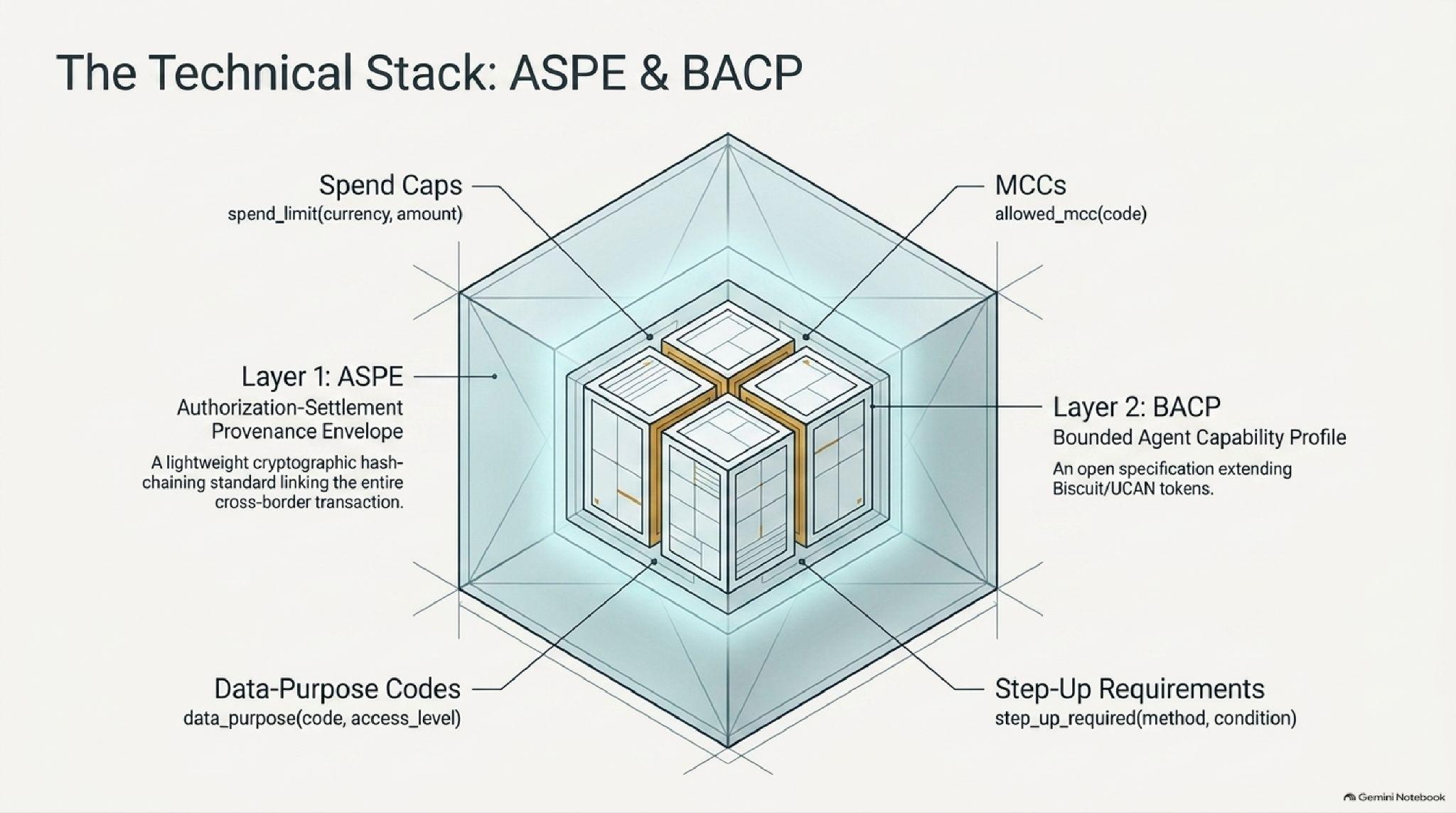
- Authorization-Settlement Provenance Envelope (ASPE) Schema: A lightweight cryptographic hash-chaining standard linking:

- Bounded Agent Capability Profile (BACP): An open specification extending Biscuit/UCAN tokens with standardized Datalog predicates for spend caps, MCCs, data-purpose codes, and step-up requirements.
- Techno-Legal Evidence Model: A formal mapping demonstrating how ASPE provenance chains satisfy the evidential requirements of UNCITRAL MLETR and eIDAS 2.0 Article 43.
Research gaps:
- How can cryptographic revocation lists propagate across partitioned, offline, or low-bandwidth environments within strict financial risk windows?
- What Zero-Knowledge Proof constructions can prove compliance with a Datalog spend/purpose caveat without revealing sensitive underlying transactional attributes?
- How can dispute arbitration protocols deterministically assign liability between the model provider, the agent operator, and the Principal when execution traces diverge within authorized boundaries?